
Who should ask a doctor before starting
Before your first ice bath, some situations call for a doctor's opinion. This is not a formality: only a professional who knows your medical history can say whether the practice suits you, and under what conditions. This page gives no medical advice and does not replace a consultation. The list below covers the cases where the question must be asked before you fill the tub, even if you feel fit and even if you already take cold showers, which are not an immersion.
Ask again if your situation changes: the start of a pregnancy, a new treatment, a recent diagnosis. If a doctor advises you against ice baths, the right decision is not to take one. A friend or relative who wants to try the tub at your home is covered by the same list: check with them before they get into the water.
- Heart disease
- High blood pressure
- Heart rhythm disorder
- Circulatory disorder, including Raynaud's syndrome
- Diabetes
- Epilepsy
- Pregnancy
- Ongoing medical treatment
Cold water shock: why you get in slowly, and never alone
The RNLI, the UK's lifeboat charity, describes a phenomenon called cold water shock. It can occur in water at 15 °C or below, so within the range often quoted for an ice bath, around 10 to 15 °C. It takes your breath away, with gasping you cannot control, and it speeds up the heart. It is not an effect to seek. That is why you get into the water gradually, without plunging in or sitting down all at once, giving your breathing time to stay calm.
It is also the reason for the simplest rule: never take an ice bath alone. Someone present and attentive stays close by for the whole bath, not in another room or busy with something else. They watch, keep an eye on the time and can help you get out. If you live alone, plan your bath for a time when someone can be there.
| When | Check | Why |
|---|---|---|
| Before | A doctor's opinion sought if any of the listed situations applies to you | Only a doctor can answer health questions |
| Before | An attentive person present, towel and dry clothes within reach | You never bathe alone, and you get out without hunting for your things |
| Before | Temperature read, clean water, tub on a level floor that bears the load | Start less cold; about 330 kg of water when full, plus the person |
| During | Slow entry, calm breathing, head above water, 1 to 2 minutes | Cold water shock can occur in water at 15 °C or below |
| During | Get out immediately in case of dizziness, chest pain, numbness or uncontrollable shivering | These signs come before the planned time |
| After | Dry off, get dressed, move gently, then close the lid or empty the tub | No child should have access to a full tub left unwatched |
Your first ice bath, step by step
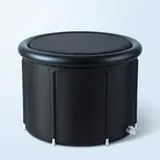
Your first bath is prepared before you get into the water. Start less cold than the 10 to 15 °C often quoted, and read the temperature on a thermometer of your own before each bath. Put a towel and dry clothes within reach, let the person staying with you know and note the time. Then get in slowly: feet first, then sit down gently on the water-filled cushion, back straight and knees bent. Depending on your height, the water comes up to your shoulders, and the inflated ring at the top of the tub acts as a neck rest.
Breathe calmly and keep your head above the water: never put your head under. Aim for 1 to 2 minutes to start with, no more, then lengthen the time gradually from one bath to the next, with no target to reach. The person with you can call out the time. Get out immediately, without waiting for the planned time to end, if any of these signs appears:
- Dizziness
- Chest pain
- Numbness
- Uncontrollable shivering
No alcohol, no drugs, no medication that makes you drowsy
An ice bath is taken with a clear head. No alcohol, no drugs and no medication that makes you drowsy, before or during the bath: no glass of wine after a meal just before getting in, no improvised dip to round off an evening. This is not about morals but about staying alert. Getting in slowly, counting the minutes, recognising dizziness or numbness and getting out at once all require a clear mind. The person with you must also stay attentive from start to finish.
If you take a medicine and do not know whether it makes you drowsy, its leaflet or a pharmacist can tell you. Ongoing treatment is in any case one of the situations to mention to your doctor before your first bath. If in doubt, postpone: the tub stays closed under its lid and the bath can wait until the next day.
Children and drowning: lid closed, tub emptied
The tub is not for children. According to the US Consumer Product Safety Commission (CPSC), drowning is the leading cause of death for children aged 1 to 4, and bathtubs, buckets and spas in the home are among the places involved. A tub 68 cm deep inside and filled with water falls into this category, even when it looks calm and even when it sits in a corner of the garden where people rarely go.
Three habits are enough: lid closed when not in use, tub emptied when nobody is watching it, and never a child near it without an adult. The lid does not replace supervision, it adds to it. If you keep the same water for several days, place the tub where the children of the house, or visiting children, do not go on their own.
Setting up the tub properly: a floor that bears the load and clean water
When full, the tub holds up to 330 litres, or about 330 kg of water, plus the weight of the person. Set it on a floor that is level, stable and able to bear that load. For a balcony or an upper floor, ask the building's managing agent or your landlord what load is allowed before filling it. Plan where the water will go too: drain it outdoors, in a shower or over a drain, through the side hose or the bottom plug, never by tipping over the full tub, as the support tubes can slip.
The water must stay clean: the supplier advises changing it every 10 to 15 days. Clean the tub each time you empty it, dry it before folding it and do not let the water freeze inside. The Ice Bath Tub shop sells a single tub of this type, foldable, insulated and closed by a lid, as a complete kit (the contents of the box: the tub and its 6 tubes, lid, dust cover, pump, cushion, drain, repair patches and carry bag), delivered free from stock held in your region.
Frequently asked questions
Is a 3-minute ice bath safe?
No duration suits everyone, and nobody can promise you an ideal one. The rule is to start with 1 to 2 minutes, then lengthen gradually from one bath to the next, getting out at the slightest discomfort. Whether 3 minutes suits you, given your health, is a question for a doctor, not for a shop.
Should you warm up after an ice bath?
Yes, simply: dry yourself as soon as you get out, put on dry clothes and move gently, for example by walking for a few minutes. Get your towel and clothes ready before getting in so you are not left waiting, wet, beside the tub. The person with you stays until you are dressed, then the lid is closed or the tub emptied.
Can a teenager use the tub?
The tub is not for children, and the shop gives no age from which it would become suitable: it cannot answer this question for a teenager, and any health question about a young person and cold water is one for a doctor. Whoever uses the tub, the same rules apply: never alone, an attentive adult present throughout the bath, lid closed when not in use.
Sources
- RNLI, Cold water shock
- U.S. Consumer Product Safety Commission (CPSC), In-Home Drowning Safety Information Center
Our guides are based on the supplier's product listing and public documentation. We have not tested the tub ourselves.


