
Your bathtub: the cheapest way to start
The bath you already have is the simplest way to try an ice bath: nothing to buy except the ice. Its limits show up quickly. It holds a lot of water, and every litre you want to cool takes its share of ice, so you need whole bags of it to drop a few degrees. The bathroom is often a warm room, and a bath has neither a lid nor an insulated wall, so the water warms up fast while you get ready. Finally, you lie down in it more than you sit, and it is rare to be able to sit upright with the water up to your shoulders.
To use less ice, fill only as much as you need, start with the coldest tap water you can get and add the ice at the last moment. Measure the temperature rather than guessing it. The bathtub remains a good way to find out whether the routine suits you before buying dedicated equipment, and it has one advantage the other options do not always offer: the drain is already there.
Converted chest freezer: why we advise against it
The idea is widely shared: fill a chest freezer with water and run it to keep the water cold without buying more ice. It is the only home-made option that cools by itself, which explains its popularity. But it puts water, a person immersed in it and a mains-powered appliance in the same space. A freezer is not designed for anyone to get into the water it holds, and a mistake in the wiring, a seal or the installation becomes an electrical risk for the person in the water. The appliance is also heavy, and hard to move once full.
For this reason, we advise against building this set-up yourself. If you are set on it, the opinion of a qualified electrician is essential before any water goes in, for the appliance as well as the socket and the circuit that supply it. The same rule applies to any electrical appliance placed near water, chillers included: the installation has to be suitable, and a professional is the one to judge it. Think too about the weight of the whole thing once full, which calls for a level floor that can bear the load.
| Option | Starting cost and space | Cold, electricity and draining |
|---|---|---|
| Your existing bathtub | Depends on the ice (the bath is already there); no extra space | No lid or insulation, the water warms quickly; no electricity; drains through the plughole |
| Converted chest freezer | Depends on the appliance and the electrician; heavy and hard to move | Cooled by the appliance; water and mains together, an electrician's opinion is essential; draining to plan |
| Plastic trough or water butt | Depends on the model; heavy, bulky, stays in place | No lid or insulation without extras; no electricity; draining to plan |
| Insulated portable tub | About £30 to £50 for a bare foldable tub in the UK; folds into a bag | Insulated lid and 3-layer wall, ice needed; no electricity; hose with valve and plug in the bottom |
Plastic trough or water butt: plenty of volume, everything to add
A large rigid plastic trough, the livestock kind, or a water butt gives you a good volume with no frame to assemble. These containers are made for outdoors and hold water without any trouble. Their limits lie elsewhere. They are heavy and bulky: once placed, they stay put and take up a corner of the garden all year round. Above all, they come with no suitable lid and no insulation. The water then follows the temperature of the air and the sun, and the ice melts quickly behind a single exposed wall.
So you have to add everything yourself: a rigid lid that actually closes, insulation around the wall, a base under the bottom, and a way to empty it without spilling. A water butt, tall and narrow, also means climbing in and out over the top, with a stable step. These options suit people who enjoy DIY and have a garden, far less someone with only a balcony.
Insulated portable tub: foldable and covered, but no chiller
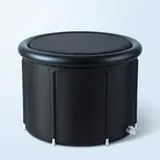
The insulated portable tub is designed for this use. The one in the kit is round, black, foldable and held up by 6 support tubes; only the top ring is inflated, to form the rim and act as a neck rest. It measures 85 cm across and 75 cm high on the outside (79 x 68 cm inside), holds 330 litres and weighs 3.8 kg empty. Its wall has 3 layers, with an aluminium-lined foam in the middle. An insulated lid closes it, a water-filled cushion lets you sit upright, and a drain hose with a valve, plus a plug in the bottom, are there to empty it.
Its limit is clear: it has no chiller and is not designed to take one. So the ice does the cooling, just as in a bathtub. The lid and the insulated wall are there to slow down warming, with no duration promised: in summer the water still warms up, which is why shade and a closed lid matter. Once emptied and dried, it folds into a zipped carry bag.
How much ice do you need, whichever option you choose?
Without a machine, none of these options does away with ice, and the amount can be calculated. Melting 1 kg of ice absorbs 334 kJ; cooling 1 litre of water by 1 °C takes 4.186 kJ. That gives the formula: ice (kg) = V x 4.186 x (starting T - target T) / (334 + 4.186 x target T), where V is the volume of water in litres. For 250 litres, which is a tub filled while leaving room for the person, this gives:
- from 20 °C to 15 °C: about 13 kg of ice
- from 20 °C to 12 °C: about 22 kg
- from 20 °C to 10 °C: about 28 kg
- from 15 °C to 10 °C: about 14 kg
These figures are a physical minimum, with no losses at all. In practice you need more, because the air, the ground and the sun keep warming the water: keep the lid closed and add the ice just before the bath. Starting with cooler water changes everything: to reach 10 °C, you need 28 kg from 20 °C against 14 kg from 15 °C. The Ice Bath Tub shop sells a single insulated portable tub with a lid, as a complete kit (the contents of the box: the tub and its 6 tubes, lid, dust cover, pump, cushion, drain, repair patches and carry bag), delivered free from stock held in your region.
Safety: the same rules for any home set-up
See a doctor before your first ice bath if you have heart disease, high blood pressure, a heart rhythm disorder, a circulatory disorder (including Raynaud's syndrome), diabetes or epilepsy, if you are pregnant or if you are on medical treatment. Never take an ice bath alone: someone present and attentive stays close by. Get in gradually, breathe calmly, start with 1 to 2 minutes and keep your head above the water. Cold water shock can occur in water at 15 °C or below: it takes your breath away and speeds up the heart, one more reason to get in slowly. Get out immediately if you feel dizzy or have chest pain, numbness or uncontrollable shivering. No alcohol, no drugs and no medication that makes you drowsy.
Ice baths are not for children, and any water stored at home is a drowning risk for them. Keep the lid closed when not in use, empty the container when nobody is watching it and never leave a child near it without an adult; a bath or trough without a lid calls for the same care. Keep any electrical appliance away from the water, unless the installation has been approved by an electrician. Finally, set the tub on a level floor that can bear the load: 330 litres of water weigh about 330 kg, plus the person.
Frequently asked questions
What is the cheapest way to start?
Your own bathtub, since it only costs the ice. It is a good way to find out whether the routine suits you. Start with water that is less cold, a short session of 1 to 2 minutes and a thermometer to follow the temperature. Someone attentive stays close by, even for a first try in the bathroom.
Is converting a chest freezer safe?
Not without a professional's opinion. You get into water held by a mains-powered appliance, which creates an electrical risk. We advise against building this set-up yourself. If you are still considering it, first have the appliance, the socket and the circuit checked by a qualified electrician, and never take the bath alone.
Can I use a water butt?
Yes, if you accept its constraints. Wash it before use and plan a stable step, as it is often tall: you need to get in and out without slipping. Add a lid that really closes, especially if there are children around, and decide how you will drain it before filling it, because it becomes very heavy once full.
Sources
- The Engineering ToolBox, Ice: thermal properties (latent heat of fusion)
- U.S. Consumer Product Safety Commission (CPSC), In-Home Drowning Safety Information Center
Our guides are based on the supplier's product listing and public documentation. We have not tested the tub ourselves.


