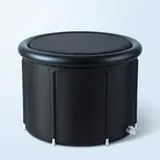

10 to 15 °C: the range often quoted, and why to start less cold
Look up a temperature for an ice bath or a cold plunge and the same range keeps coming back: roughly 10 to 15 °C. It is a practical reference taken from public guidance, not an instruction and not a promise. No figure in that range guarantees any result, and nothing suggests that one degree colder brings anything extra. It is simply the range most often quoted, and the usual advice is to start less cold and short.
For your first few sessions, move in small steps. Water slightly less cold than the quoted range lets you discover the sensation, learn to get in slowly and see how you react. Keep the bath short, 1 to 2 minutes to start, and get out at the first sign of discomfort. You can then lower the temperature or lengthen the time, ideally one setting at a time, so you know what each change comes from.
15 °C or below: cold water shock, a reason to go slowly
The RNLI, the UK's lifeboat charity, explains that cold water shock can happen in water at 15 °C or below. It takes your breath away, with uncontrolled gasping, and makes the heart beat faster. This is not something to look for: it is the reason you get into the water gradually, breathing calmly, and never put your head under. That 15 °C limit matches the top of the range often quoted, so as soon as you reach it, the safety rules matter as much as the thermometer.
Never take an ice bath alone: someone present and attentive stays close by. Before your first bath, see a doctor if you have heart disease, high blood pressure, a heart rhythm disorder, a circulatory disorder (including Raynaud's syndrome), diabetes or epilepsy, if you are pregnant or if you are on medical treatment. No alcohol, no drugs and no medicine that makes you drowsy before or during the bath. The tub is not for children, and its lid stays closed when it is not in use.
- Get in gradually and breathe calmly.
- Start short: 1 to 2 minutes.
- Keep your head above the water.
- Get out immediately if you feel dizzy or have chest pain, numbness or uncontrollable shivering.
| Water temperature | What it means when starting out | Ice for 250 litres starting at 20 °C |
|---|---|---|
| 20 °C | Fresh water, above the range often quoted; starting point of the worked example | None (starting temperature) |
| 15 °C | Top of the range often quoted; cold water shock threshold according to the RNLI, so get in slowly and never alone | About 13 kg |
| 12 °C | Middle of the range often quoted; worth considering once your routine is settled | About 22 kg |
| 10 °C | Bottom of the range often quoted; no extra effect promised | About 28 kg |
Measuring the water with a thermometer
A temperature is read, not guessed: your hand is not a measuring tool, and cold water is hard to place to within a few degrees by feel alone. A thermometer is not included in the kit: plan a floating bath thermometer of your own. Leave it floating in the tub while you get ready and read it just before you get in, not the moment you finish filling: the water may have changed in between.
After adding ice, stir the water for a few moments, then let the reading settle before you note it down. Ice cools the water around it first: without stirring, the thermometer may show the temperature of a single layer of water. Write down the reading along with the length of the bath. From one session to the next, this small log shows you where you are starting from and how your routine is changing.
Tap water, season, lid: what changes the starting temperature
The starting temperature depends first on the water you fill the tub with. Water from the tap or the garden hose does not arrive at the same temperature from one season or one home to the next: measure it with your thermometer rather than assume it, every time you fill up. A tub filled in advance and left with the lid closed slowly moves towards the temperature of the place it stands in, cooler when it is cold outside, warmer when it is hot, especially in the sun.
In summer the water warms up: the tub is insulated, but it has no chiller and does not hold the cold like a tub cooled by a machine. To narrow the gap, keep the lid closed between baths, put the tub in the shade, away from sun-warmed paving, and add the ice just before the bath. No figure for how long the cold lasts is given here: no test allows us to state one.
How much ice to reach a target temperature
The amount of ice can be worked out. Melting 1 kg of ice absorbs 334 kJ, and cooling 1 litre of water by 1 °C takes 4.186 kJ. From this comes a simple formula: ice (kg) = V x 4.186 x (starting T - target T) / (334 + 4.186 x target T), where V is the volume of water in litres. The examples below are for 250 litres, the volume of the 330-litre tub filled while leaving room for the person sitting in it.
These figures leave out losses: the air, the ground and the sun warm the water while the ice melts, so in practice you need more. Two habits narrow the gap: keep the lid closed and add the ice just before the bath. The last example also shows the value of cooler starting water: starting from 15 °C rather than 20 °C roughly halves the ice needed to reach 10 °C.
- From 20 °C to 15 °C: about 13 kg of ice.
- From 20 °C to 12 °C: about 22 kg of ice.
- From 20 °C to 10 °C: about 28 kg of ice.
- From 15 °C to 10 °C: about 14 kg of ice.
The tub's -20 to 60 °C range is not a target
The supplier states a working range for the material of -20 °C to 60 °C. That figure describes what the wall can withstand, not the water temperature to choose for an ice bath, and it says nothing about what suits a person. For that, the reference points remain the ones in this guide: less cold water to start, then the often quoted range of 10 to 15 °C. Never let the water freeze in the tub: when frost is on the way, empty it through the side hose or the bottom plug, never by tipping it over.
Empty it outside, into a shower or over a floor drain, change the water regularly (the supplier advises every 10 to 15 days) and dry the tub before folding it. The Ice Bath Tub shop sells a single product: a round, foldable, insulated tub with a lid, as a complete kit (the contents of the box: the tub and its 6 tubes, lid, dust cover, pump, cushion, drain, repair patches and carry bag). It is delivered free from stock held in your region.
Frequently asked questions
Is 15 °C water cold enough for an ice bath?
Yes: 15 °C sits within the range often quoted, at its least cold end. It is also the temperature from which the RNLI warns of a risk of cold water shock. For a first bath, that is already cold water: get in slowly, stay for 1 to 2 minutes with an attentive person beside you, and only go lower once your routine is settled.
Is colder water better?
No. Nothing promises more of an effect at a lower temperature, and no result is tied to a precise figure. Going below the range often quoted mainly takes more ice and makes getting in harder. To start, less cold water and a short bath remain the right base; you can then adjust in small steps, getting out at the first sign of discomfort.
Why does my thermometer show a different reading at the top and the bottom of the tub?
Because the water does not mix on its own. Just after you add ice, the meltwater stays colder near the cubes, while the rest of the tub has not changed yet. Stir the full depth of the water for a few moments, let the thermometer settle, then read it again: that reading, taken on evenly mixed water, is the one that counts for your bath.
Sources
Our guides are based on the supplier's product listing and public documentation. We have not tested the tub ourselves.


