Bathtub or a dedicated ice bath for home?
The bath you already own is the cheapest way to try: nothing to buy but the ice. Its limits show quickly. It holds a lot of water, and every litre needs its share of ice, so you tip in whole bags to drop a few degrees. Bathrooms are often warm, and a bath has neither a lid nor an insulated wall, so the water warms while you get ready. You also tend to lie in it rather than sit upright with the water at your shoulders.
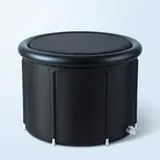
A dedicated tub deals with those points. This one is round, 79 cm across and 68 cm deep inside, so you sit with your back straight and knees bent on a water-filled cushion. Its three-layer wall, with aluminium-lined foam in the middle, and its insulated lid slow the warming, although it has no chiller and still relies on ice. Six support tubes hold the wall; only the top ring is inflated, with the hand pump supplied.
Garden, garage or flat: where to put your ice bath
Full, the tub holds about 330 kg of water, plus you, on a circle 85 cm across. Whatever the room, the floor must be flat, stable and able to carry that load. In the garden, paving or a compacted patio beats a domed lawn, and a shady corner keeps the black wall out of the sun. In a garage or utility room, a floor drain is ideal. In a flat, upstairs or on a balcony, ask your managing agent, freeholder or landlord what load is allowed before you fill it: the answer depends on the building, not on how the floor looks.
Plan the draining before the first fill. The side hose with its valve should reach a drain, a shower or a garden border; indoors, the bottom plug can sit right over a floor drain. On a balcony, check that the building's rules let you empty water into its outlet, or the neighbours below may find out before you do.
| Home bathtub | Trough or water butt | Insulated foldable tub (the kit) |
|---|---|---|
| Ice needed: a lot, as the whole bath has to be cooled | Ice needed: depends on the volume filled | Ice needed: at least about 28 kg for 250 litres from 20 °C to 10 °C |
| Holding the cold: no lid, no insulation, often a warm room | Holding the cold: no lid or insulation unless you add them | Holding the cold: insulated lid and 3-layer wall, no chiller |
| Position: you mostly lie down | Position: depends on the shape, often climbing in over a high edge | Position: seated upright on a water-filled cushion |
| Space: nothing extra, the bath is already there | Space: heavy and bulky, stays where it is | Space: 85 cm across, folds into a 75 x 44 cm bag |
| Draining: through the plughole | Draining: to plan yourself | Draining: side hose with valve, or bottom plug over a drain |
Filling and cooling a home ice bath
Fill to about 250 litres rather than to the brim: your body takes up the rest. Start with the coldest tap water you can get, close the lid and add the ice only just before you get in. The amount can be worked out: melting 1 kg of ice absorbs 334 kJ, and cooling 1 litre of water by 1 °C takes 4.186 kJ. For 250 litres, the minimum with no losses at all is about 13 kg to go from 20 °C to 15 °C, 22 kg to reach 12 °C and 28 kg to reach 10 °C.
From 15 °C, reaching 10 °C takes about 14 kg. In practice, allow more: the air, the ground and the sun keep warming the water, especially in summer. Temperatures often quoted for an ice bath sit around 10 to 15 °C, and it makes sense to start less cold. A bath thermometer of your own, not included in the kit, tells you where you are before you get in.
How to take an ice bath at home: your first one, step by step
See a doctor first if you have heart disease, high blood pressure, a heart rhythm disorder, a circulatory disorder (including Raynaud's syndrome), diabetes or epilepsy, if you are pregnant or if you are on medical treatment. Never take an ice bath alone: someone present and attentive stays close by. No alcohol, drugs or medication that makes you drowsy, before or during the bath. Get in slowly, breathing calmly, and sit on the cushion with your head well above the water. The RNLI notes that cold water shock can occur at 15 °C or below: it makes you gasp and speeds up the heart, which is why you enter gradually.
For a first ice bath, 1 to 2 minutes is enough; you can lengthen sessions gradually later, and there is no ideal duration to chase. Get out at once if you feel dizzy or have chest pain, numbness or uncontrollable shivering. Keep a towel and warm clothes within reach. Many people say they like the feeling of freshness afterwards, but that is a matter of taste, not a promise.
After the bath: emptying, water changes and storage
Close the lid as soon as you get out. Ice baths are not for children, and any water stored at home is a drowning risk for them: keep the lid closed when not in use, empty the tub when nobody can watch it and never leave a child near it without an adult. To empty it, always use the drain hose or the bottom plug, never tip the tub: full, it is far too heavy, and the support tubes can slip when it is tilted.
The supplier advises changing the water every 10 to 15 days. Before folding the tub away, let it dry completely with the lid open. Outdoors in winter, the water must never freeze in the tub: empty, dry and fold it before hard frosts. Folded, it fits in its zipped 75 x 44 cm bag, in a cupboard, a shed or a car boot.
Buy an ice bath for home: kit, delivery and returns
The Ice Bath Tub shop sells one model, this tub, as a complete kit: tub with 6 support tubes, insulated lid, thermal dust cover, hand pump, water cushion, drain hose and valve, 2 repair patches, 2 seals, carry bag and instructions. There is no thermometer and no floor mat in the box. Delivery is free from stock held in the UK, with no customs step: preparation takes 1 to 2 business days, then delivery 2 to 5 business days, as an indication, with tracking by email.
On arrival, fill it for a 24-hour leak test: leaks are the most common complaint about tubs of this type, and a leak found on receipt is exchanged on photos. You have 30 days after receipt to return the kit, satisfied or refunded, if it is complete, unused or only tried, and in its original packaging. Return postage is yours unless the item is faulty, wrong or not as described. Prices include VAT.
Frequently asked questions
Can I take an ice bath in my own bathtub?
Yes, and it is a sensible way to see whether the routine suits you. Expect to need plenty of ice, since the whole bath has to be cooled and it warms quickly without a lid. Fill only what you need, start from the coldest tap water and keep sessions short. Someone attentive should be nearby, even in the bathroom.
How much ice for 250 litres?
It depends on the water you start with. From 15 °C, about 14 kg brings 250 litres down to 10 °C; from 20 °C, about 28 kg. Those are physical minimums: warm air, a warm floor or sunshine push the figure up. Closing the lid and adding the ice at the last moment keeps the amount down.
Where should the tub go in a flat?
On a flat, load-bearing floor, ideally close to a shower or a floor drain so the hose reaches it. Full, it holds about 330 kg of water plus you, so ask the managing agent, freeholder or landlord what load is allowed, especially on a balcony or an upper floor. Until you have the answer, do not fill it.
How often should I change the water?
The supplier advises every 10 to 15 days. Keep the lid closed between sessions to keep out dust and leaves, and remove any debris before getting in. When you change the water, empty it through the hose or plug and let the tub dry before refilling it or folding it away.
How long should a first ice bath last?
One to two minutes is enough to start. You can lengthen sessions gradually over time, but there is no ideal duration to aim for. Get out straight away if you feel dizzy or have chest pain, numbness or uncontrollable shivering, and always have someone attentive close by.
Sources
- RNLI, Cold water shock
- U.S. Consumer Product Safety Commission (CPSC), In-Home Drowning Safety Information Center
- The Engineering ToolBox, Ice: thermal properties (latent heat of fusion)
Our guides are based on the supplier's product listing and public documentation. We have not tested the tub ourselves.