
The physics of ice, in plain words
Ice cools water because it has to absorb heat in order to melt. Melting 1 kg of ice absorbs 334 kJ. Cooling 1 litre of water by 1 °C means taking 4.186 kJ out of it. The calculation therefore sets two quantities against each other: the heat the bath water must lose to reach the target temperature, and the heat each kilo of ice can take in. One detail matters: once melted, the ice becomes water that still has to warm up to the bath temperature, and it takes in a little more heat on the way. That is the second term of the divisor in the formula.
The formula: ice (kg) = V x 4.186 x (starting T - target T) / (334 + 4.186 x target T), with V the volume of water in litres and temperatures in °C. Take 250 litres to bring from 20 to 12 °C. Multiply 250 by 4.186, then by the 8-degree difference. Then divide by 334 plus 4.186 times 12. You get about 22 kg. This figure counts no heat loss at all: it is a minimum, not a guaranteed amount.
Worked examples for 250 litres of water
Why 250 litres? The tub holds 330 litres, but you do not fill it to the brim: you need to leave room for the person, who raises the level when sitting on the cushion, back straight, knees bent, with the water up to the shoulders depending on height. So 250 litres is a realistic working volume. With that volume, the formula gives simple reference points. From water at 20 °C, you need about 13 kg of ice to get down to 15 °C, about 22 kg to reach 12 °C and about 28 kg to reach 10 °C.
If the water starts at 15 °C, getting down to 10 °C takes about 14 kg. Each degree gained costs a little more than the one before: about 13 kg to go from 20 to 15 °C, about 14 kg for the next five degrees. The reason lies in the divisor: the lower the target temperature, the less heat the meltwater takes in as it warms up. For another volume, simple proportion is enough, because the amount of ice is proportional to the volume of water.
| Starting water | Target temperature | Ice to allow, approx. |
|---|---|---|
| 20 °C | 15 °C | 13 kg |
| 20 °C | 12 °C | 22 kg |
| 20 °C | 10 °C | 28 kg |
| 15 °C | 10 °C | 14 kg |
Why you need more ice in real life
The formula describes a perfectly insulated bath, where all the heat taken from the water goes into the ice. In real life, the tub exchanges heat with everything around it. Air that is warmer than the water heats it through the surface and through the wall. The ground passes its heat through the base, especially a slab or a patio that has warmed up during the day. The sun heats the water and the wall directly. Every time the lid is opened, warm air gets in. All these losses add up while the ice melts.
How much more? No reliable figure can be given here: the gap depends on the season, the exposure and the time between adding the ice and getting in. The dependable method is to start from the calculation, add the ice, then read the actual temperature before getting in. The 3-layer wall, with a foam lined with aluminium, and the insulated lid slow these exchanges down. Even so, this tub does not hold the cold like a tub fitted with a chiller, which cools the water continuously: in summer, the water in it warms up.
Keeping the water cold without a chiller
Without a machine, it all comes down to two ideas: limit the heat that gets in and add the cold at the right moment. The insulated lid stays closed outside bath time, with the thermal dust cover on top. The tub goes in the shade, or at least out of direct sun during the hottest hours. Ground that has sat in the sun, such as a warm patio, passes heat through the base, so a shaded spot helps here too. Finally, the ice goes in just before the bath, not hours ahead: the longer it waits, the more it melts to make up for losses instead of cooling the water.
The shape of the ice matters too. A block of ice melts more slowly than the same weight of cubes, because it offers less surface to the water: it cools less quickly, but for longer. Cubes are the choice for bringing the temperature down fast just before you get in. Another option: reusable ice packs or frozen bottles of water, which go back in the freezer after use. A frozen bottle of water is ice: count it by the kilo, just like cubes.
Measuring with a thermometer of your own
The calculation gives an estimate; a thermometer gives the reality. None comes in the kit, so plan a floating bath thermometer of your own. Measure twice: first before adding the ice, to know your starting temperature and get the calculation right, then a few minutes later, once the ice has partly melted and the water has been stirred. If the water is still above your target, add ice in small amounts and measure again. Keep a note of your readings from one bath to the next: they will soon tell you what your set-up really needs.
The temperatures often quoted for an ice bath sit around 10 to 15 °C. Start less cold and short: 1 to 2 minutes to begin with, then build up gradually. Cold water shock can happen in water at 15 °C or below: it takes your breath away and makes the heart beat faster. That is why you get in gradually, breathe calmly, keep your head above the water and never bathe alone. Get out immediately if you feel dizzy or have chest pain, numbness or uncontrollable shivering.
- See a doctor before your first ice bath if you have heart disease, high blood pressure, a heart rhythm disorder, a circulatory disorder (including Raynaud's syndrome), diabetes or epilepsy, if you are pregnant or if you are on medical treatment.
- Someone present and attentive stays close by for the whole bath.
- No alcohol, no drugs and no medicine that makes you drowsy before or during the bath.
- Not for children: lid closed when not in use, tub emptied when no one is watching it, and never a child nearby without an adult.
The ice calculator on the home page
To save you working the formula out by hand, the ice calculator on the home page applies it for you. You enter the water in the tub, the starting temperature read on your thermometer and the target temperature: it shows roughly how much ice to allow. If the target is not lower than the water temperature, it tells you that no ice is needed. Like the formula, it only counts the melting of the ice: treat its result as a minimum, keep the lid closed and add the ice just before. This calculation is not temperature advice.
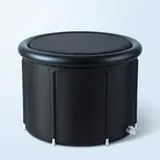
Ice Bath Tub sells one tub: a round, foldable, insulated ice bath in black, with a lid, delivered as a complete kit (the contents of the box: the tub and its 6 tubes, lid, dust cover, pump, cushion, drain, repair patches and carry bag). It ships free from stock in your region, with no customs step for you. A thermometer is not included: plan one of your own.
Frequently asked questions
How many bags of ice should I buy?
It depends on the weight printed on the bag. Divide the amount you have calculated by that weight, then round up to the next bag: for about 22 kg, divide 22 by the weight of one bag. As the calculation counts no losses, allow a margin, especially in warm weather, and keep the bags cold until you tip them into the tub.
Can reusable ice packs replace ice?
Partly, yes. How well they cool depends on what they contain and how much they weigh. A frozen bottle of water follows the same formula as ice; a gel pack does not. Put them in just before the bath, lid closed, and check the result with your thermometer. They have one advantage: they add no meltwater to the tub.
Does salt make the water colder?
Salt lowers the melting point of ice. Even so, do not add any to the tub: its effect on the materials of the wall, the cushion and the seals is not documented. Keep it simple: clean water, ice, the lid closed and your thermometer to check the result before you get in.
Sources
Our guides are based on the supplier's product listing and public documentation. We have not tested the tub ourselves.


