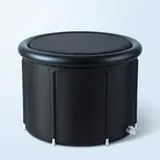

The ice bath: immersion in water cooled with ice
An ice bath means sitting in a tub or a bath filled with cold water, then adding ice to bring the temperature down. The ice gives the practice its name: without a machine, it alone cools the water. Temperatures often quoted for an ice bath are around 10 to 15 °C. The amount of ice can be worked out: melting 1 kg of ice absorbs 334 kJ, and cooling 1 litre of water by 1 °C takes 4.186 kJ. For 250 litres of water, that means about 13 kg of ice to go from 20 °C to 15 °C, and about 28 kg to get from 20 °C down to 10 °C.
These figures are physical minimums: in practice, the air, the ground and the sun warm the water, and you need more ice. Two habits limit these losses: keep the lid closed between uses and add the ice just before the bath. An ice bath remains simple in terms of kit (a tub, water, ice), but it means planning the ice for every session, especially in warm weather.
The cold plunge: the same immersion, often with a machine
Cold plunge literally means a plunge into the cold. The action is the same as for an ice bath: you immerse yourself in cold water, sitting down, with your head above the surface. The difference lies mostly in how the term is used. Cold plunge is often used for tubs cooled by a machine called a chiller: an electric unit with a pump that cools and filters the water continuously. The water then stays cold without any added ice. Yet the two terms describe the same immersion and overlap widely: a tub filled with ice can also be called a cold plunge.
Tubs designed for a chiller are mainly rigid inflatable tubs, known as drop stitch, of 500 to 800 litres, weighing 16 to 19 kg empty. An electrical appliance placed near water requires a suitable electrical installation, to be checked by an electrician. Before buying, bear in mind that a tub designed for water and ice is not necessarily built to take a chiller: the two uses do not call for the same equipment.
| Ice bath | Cold plunge | Cold shower |
|---|---|---|
| What it is: immersion in cold water cooled with added ice | What it is: the same immersion, a term often used for a tub cooled by a machine | What it is: a stream of cold water in the shower, without immersion |
| Water: filled from the tap, ice added just before the bath, 10 to 15 °C often quoted | Water: cooled and filtered continuously by an electric chiller | Water: from the mains, at the temperature of the season |
| Equipment: a tub and ice for every session | Equipment: a compatible tub, a chiller, an electrical installation checked by an electrician | Equipment: your existing shower |
| Space: flat, load-bearing ground (330 L of water weigh about 330 kg, plus the person) | Space: tubs often of 500 to 800 L, plus the machine and a suitable socket | Space: none extra |
The cold shower: cold water, but not an immersion
A cold shower means standing under a stream of cold water in your usual shower. It is not an immersion: the body is not plunged into a volume of water, the water runs over you and drains away. Its temperature depends on the mains supply and the season, with no ice or machine to set it. Some people simply finish their shower with a few moments of cold water, others take it cold from start to finish: it is a matter of personal habit. No tub, no ice, no extra space: the bathroom is enough.
A cold shower and an ice bath are two different practices, and this guide does not compare their effects. They differ in concrete ways. In the shower, you stand, adjust the flow and step out in one stride. In a tub, you sit with your back straight and your knees bent, the water comes up to your shoulders depending on your height, and you have to fill, cool, watch over and then empty a volume of water. The routine, the preparation and the upkeep have almost nothing in common.
Ice bath, Eisbad, baño de hielo: the words in other countries
In English, people talk about an ice bath or a cold plunge, and the tub itself is often called a cold plunge tub. In French, the terms are bain froid, bain glacé or bain de glace, and the English words ice bath and cold plunge are widely used too. In German, you will find Eisbad for the bath itself, Eistonne for the tub and Eisbaden for the practice. In Spanish, it is baño de hielo for the bath and bañera de hielo for the tub. In Italian, bagno di ghiaccio and vasca ghiaccio. All these terms describe the same thing: immersion in cold water, most often with added ice.
In Italy and Spain, a word borrowed from medical vocabulary is also used for these tubs, simply as a category name. Here, the tub is never presented as a medical device or as a form of care: it is a container of cold water for a personal practice, nothing more. If you read a translated instruction leaflet or compare tubs sold in another country, these words will help you recognise the same type of product.
What you need at home for each practice
For an ice bath, you need a tub and ice. The tub goes on flat, stable ground able to carry the load: 330 litres of water weigh about 330 kg, plus the weight of the person. On a balcony or an upper floor, ask the building's managing agent or your landlord what load is allowed. For a cold plunge with a chiller, you need a compatible tub, the machine, a socket and a suitable electrical installation, checked by an electrician. For a cold shower, your existing shower is enough.
On budget, UK public prices recorded on 28/09/2026 give orders of magnitude by category. A round foldable tub sold on its own, without accessories, costs about £30 to £50. A rigid inflatable tub compatible with a chiller comes in at around £399, machine not included. Tub and chiller sets belong to another price bracket. On top of that comes the ice for each session for an ice bath, and the electricity for the machine. A cold shower requires no purchase at all.
- Ice bath: a tub, ice, water changed regularly, flat and load-bearing ground, somewhere to empty the water.
- Cold plunge with a chiller: a compatible tub, the machine that cools and filters the water, an electrical installation checked by an electrician.
- Cold shower: the shower in your bathroom, nothing else.
The safety rules shared by every immersion
Ice bath or cold plunge, the rules are the same, since you are immersed in cold water. Before your first ice bath, see a doctor if you have heart disease, high blood pressure, a heart rhythm disorder, a circulatory disorder (including Raynaud's syndrome), diabetes or epilepsy, if you are pregnant or if you are on medical treatment. Never take an ice bath alone: someone present and attentive stays close by. A British sea rescue organisation points out that cold water shock can occur in water at 15 °C or below: it takes your breath away and speeds up the heart. That is a reason to get in slowly, never an effect to seek out.
The tub also calls for care when nobody is using it. It is not for children: at home, the drowning risk also covers baths, buckets and hot tubs. Close the lid when the tub is not in use, empty it when nobody is watching it and never leave a child near it without an adult. The Ice Bath Tub shop sells a single tub of this type, foldable, insulated and closed by a lid, as a complete kit (the contents of the box: the tub and its 6 tubes, lid, dust cover, pump, cushion, drain, repair patches and carry bag), delivered free from stock held in your region.
- Get in gradually and breathe calmly.
- Start short, 1 to 2 minutes, then lengthen gradually.
- Keep your head above water.
- Get out immediately if you feel dizzy, have chest pain, go numb or start shivering uncontrollably.
- No alcohol, drugs or medication that makes you drowsy before or during the bath.
Frequently asked questions
Is a cold plunge the same thing as an ice bath?
As an action, yes: in both cases you sit in cold water with your head above the surface. Only the use of the words changes. People tend to say ice bath when ice cools the water, and cold plunge when a machine does the job. A foldable tub filled with water and ice is therefore an ice bath, even though the term cold plunge can describe it too.
What is a cold plunge tub called in other languages?
In English, you will see cold plunge tub or ice bath. In German, look for Eistonne for the tub and Eisbad for the bath. In Spanish, the tub is a bañera de hielo and the bath a baño de hielo. In Italian, you will find vasca ghiaccio for the tub and bagno di ghiaccio for the bath. These words help when comparing listings written in another language.
Can a cold shower replace an ice bath?
They are two different practices, and no effect is compared here. A cold shower needs no tub, no ice and no extra space. An ice bath means filling, cooling and emptying a tub, with someone present beside you. The choice therefore depends on what you want to practise and what you can organise at home, not on any equivalence between the two.
Sources
Our guides are based on the supplier's product listing and public documentation. We have not tested the tub ourselves.


