Bathtub ice bath or a dedicated ice bath for home?
The bathtub you already own is the easiest way to try an ice bath at home: the only thing to buy is ice. Its limits show up quickly. You have to chill every gallon you run, the bathroom is warm, and a bathtub has no lid and no insulated wall, so the water warms while you get ready and the ice melts fast. You also lie back more than you sit, and the water rarely reaches your shoulders with your back straight.
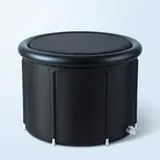
A dedicated ice bath tub for home turns that around. You sit upright, knees bent, in water that can come up to your shoulders depending on your height, and the insulated wall and lid slow the warming between sessions. The tub in this kit is 33.5 in (85 cm) across and 29.5 in (75 cm) tall, holds 87 gallons (330 L), weighs 8.4 lb empty and folds into a bag when you are done.
Where to put your home ice bath
Full, the tub holds about 730 lb of water, plus your own weight, resting on a circle 33.5 in across. Set it on level, stable ground that can carry that load: a patio slab, a porch, a garage or a laundry room floor. On a balcony or an upper floor, ask your HOA, building manager or landlord what load is allowed before filling anything, and do not judge by how the floor looks. Leave room to walk around the tub and lift the lid.
Then plan where the water goes. The side hose with its valve should reach a drain, a shower or a spot in the yard that can take the water; indoors, the bottom plug can sit right over a floor drain. A badly placed drain can flood a room. Outdoors, shade matters: direct sun warms the black wall and the water inside.
| Your bathtub | Insulated foldable tub (this kit) | |
|---|---|---|
| Ice needed | A lot: all the water you run gets chilled, with nothing to hold the cold | About 48 lb for 66 gal from 68 °F to 54 °F in theory, more in practice |
| Holding the cold | No lid, no insulation, often a warm room | 3-layer insulated wall and padded lid; still warms in summer |
| Position | Lying back, water rarely at shoulder height | Sitting upright on a water cushion, knees bent |
| Space | None extra, the bathroom is already there | About 33.5 in across; floor must carry about 730 lb when full |
| Draining | Through the tub drain | Side hose with valve, or bottom plug over a drain |
| Storage | Nothing to store | Folds into a 29.5 x 17.3 in zipped bag |
Filling and chilling an ice bath at home
Fill to about 66 gallons (250 L), which leaves room for your body, rather than to the brim. Start with the coldest tap water you have; in winter it already does part of the work. Then comes the ice, which does the real cooling in a tub without a chiller. Temperatures often cited for an ice bath sit around 50 to 59 °F. A physics calculation, with no losses counted, gives these orders of magnitude for 66 gallons of water starting at 68 °F:
- To 59 °F: about 29 lb of ice
- To 54 °F: about 48 lb of ice
- To 50 °F: about 61 lb of ice
- From 59 °F down to 50 °F: about 31 lb of ice
In practice you need more, because the air, the ground and the sun keep warming the water. Keep the lid closed and add the ice just before you get in rather than the night before. The kit has no thermometer, so bring a bath thermometer of your own to see where you stand, and aim a little warmer for your first sessions.
How to take an ice bath at home: your first plunge
Before a first ice bath, see a doctor if you have heart disease, high blood pressure, a heart rhythm disorder, a circulatory disorder (including Raynaud's syndrome), diabetes or epilepsy, if you are pregnant or if you are on medical treatment. Cold shock can happen in water at 59 °F or below: it takes your breath away and speeds up your heart, which is why the steps below matter. Skip alcohol, drugs and any medication that makes you drowsy, before and during the bath.
Add time later at your own pace, without chasing a number: there is no ideal duration to aim for. Whether you plunge before or after a workout, morning or evening, is a matter of your schedule. The tub is not for children, and water stored at home is a drowning risk for them: keep the lid closed when not in use and empty the tub when no one is watching it.
- Have someone present and attentive nearby: never plunge alone.
- Get in slowly and breathe calmly.
- Sit on the water cushion, back straight, head above water.
- Stay 1 to 2 minutes for a first session, then get out.
- Get out right away if you feel dizzy or have chest pain, numbness or uncontrollable shivering.
- Close the lid as soon as you step out.
After the plunge: draining, fresh water and storage
Keep the same water for several sessions with the lid closed, and change it every 10 to 15 days, as the supplier's text advises, sooner if it turns cloudy. To empty the tub, open the valve on the side hose and run it to a drain, a shower or the yard, or pull the bottom plug over a floor drain. Never tip the tub to empty it: full, it is far too heavy, and the support tubes can slip out of place.
When the season ends or you need the space back, rinse the tub, let it dry completely, then fold it into its bag. In cold weather, never let water freeze inside it. When the tub first arrives, fill it and leave it for 24 hours to check for leaks, the flaw most often mentioned in public reviews of this kind of tub.
What's in the ice bath kit, delivery and returns
The Ice Bath Tub shop sells the tub as a complete kit, exactly the supplier's box: the tub with its 6 support tubes, the insulated lid, the thermal dust cover, the hand pump for the top ring, the water cushion, the drain hose and 1/2 in valve, 2 repair patches, 2 seals, the zipped carry bag and the instructions. If you find a leak when it arrives, you can get an exchange based on photos. There is no thermometer or floor mat in the box.
Delivery is free and ships from stock in the US, so there is no customs step. Orders are prepared in 1 to 2 business days, then delivered in about 3 to 8 business days, an indicative window rather than a promised date, with a tracking number by email. You have 30 days after delivery, satisfied or refunded, for a complete kit, unused or only tried, in its original packaging; return shipping is yours unless the item is defective, wrong or not as described.
Frequently asked questions
Can I take an ice bath in my bathtub?
Yes, and it is a cheap way to see whether the routine suits you. Expect to use a lot of ice, since there is no lid or insulation and the room is warm, and you will lie back rather than sit upright. The same safety rules apply: someone attentive nearby, a short first session and your head above water.
How much ice for 66 gallons of water?
It depends on how warm your tap water is and how cold you want it. From 68 °F, count about 48 lb to reach 54 °F in theory, and about 31 lb to go from 59 °F to 50 °F. Air, ground and sun add losses, so buy a little more and add it at the last moment.
Where can the tub go in an apartment?
On a level floor that can carry about 730 lb of water plus you, ideally near a floor drain or a shower the hose can reach. For a balcony or any upper floor, check the allowed load with your HOA, building manager or landlord first. A tarp under the tub protects flooring that does not handle water well.
How often should I change the water?
The supplier's text advises fresh water every 10 to 15 days, sooner if it looks cloudy or smells. Keeping the lid closed and rinsing off before you get in helps the water last. Drain through the hose or the bottom plug, never by tipping the tub, and let it dry before folding.
How long should a first ice bath last?
Start with 1 to 2 minutes, then add time gradually over later sessions if it feels right. Get out at the first sign of discomfort, such as dizziness, chest pain, numbness or shivering you cannot control. There is no target to reach, and nobody should plunge alone, even for a short session.
Sources
- RNLI, Cold water shock
- U.S. Consumer Product Safety Commission (CPSC), In-Home Drowning Safety Information Center
- The Engineering ToolBox, Ice: thermal properties (latent heat of fusion)
Our guides are based on the supplier's listing and public documentation. We have not tested the tub ourselves.