
What is an ice bath chiller?
A chiller is an electric unit that sits next to the tub and connects to the water through hoses. Its pump moves water from the tub through the unit, which cools and filters it, then sends it back into the tub. This loop runs continuously, so the water stays cold without adding ice before each session. That is what separates the two terms you see everywhere. 'Ice bath' puts the emphasis on ice added just before you get in, with the water slowly warming afterward. 'Cold plunge' is often used for tubs cooled by a machine. Either way, it means immersion in cold water.
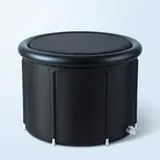
For the tub in our kit, the answer is simple: it has no chiller and is not designed to take one. It is a round, foldable, insulated tub held up by 6 vertical support tubes, and only the ring at the top inflates. Its two drains, a side hose with a valve and a plug in the bottom, are there to empty it, not to connect a unit. You cool it with ice and protect the cold with its insulated lid.
Which tubs can take a chiller?
Tubs built to run with a chiller are mostly rigid inflatable tubs, known as 'drop stitch' tubs. They hold about 132 to 211 gallons and weigh about 35 to 42 lb empty. The foldable tub in the kit plays in another category: 87 gallons, 8.4 lb empty, 33.5 in across on the outside and 29.5 in tall (85 x 75 cm), with a zipped carry bag to store it. These numbers describe two different uses. On one side, a larger setup designed to stay in place with its unit. On the other, a tub you set up alone, with no tools, then drain and fold when the season or the space calls for it.
More gallons also mean more water to cool and a heavier load on the floor than the roughly 730 lb of the kit's tub when full, not counting the person. On a balcony or an upper floor, ask the building manager or the condo association what load is allowed. Before buying a separate chiller, check with the seller of the tub and the seller of the unit that the two are designed to work together.
| Criterion | Ice with the kit's portable tub | Rigid tub with a chiller |
|---|---|---|
| Price range | Kit price shown on the product page; bare foldable tubs around $44 to $64 in the US, plus the ice | Rigid tub alone about $199 to $349 in the US; tub and chiller set about $649 to $1,099 in the US |
| Setup | Set up alone, no tools; 87 gallons, 8.4 lb empty, folds into its bag | Tub of about 132 to 211 gallons, 35 to 42 lb empty, plus the unit and its hoses |
| Electricity | None for the tub | Unit on household power; wiring suited to use near water, checked by an electrician |
| Noise | No unit, so no motor noise | Depends on the model: see the unit's spec sheet |
| Maintenance | Change the water every 10 to 15 days (supplier's advice), dry the tub before folding it | Water pumped and filtered continuously; unit maintenance as set out in its manual |
What a chiller changes, and what it requires
The gain is clear: the water stays cold without ice. No more bags to buy, carry and empty into the tub before each session, and a temperature that no longer depends on how much ice you have on hand. For someone who gets in the water every day, that is a real difference in routine. In return, the unit has a price, it takes up space next to a tub that is already larger, and it runs on household power. Above all, an electric unit near water calls for suitable electrical wiring: have it checked by an electrician before you switch it on for the first time.
Noise and power use depend on the model: rely on the unit's spec sheet and manual, not on a general promise. Think about placement too: the unit runs while you are not around, next to a tub full of water, often outdoors in the backyard. It is not something you move from one weekend to the next. Before choosing, go through these four points, ideally with the electrician who will check the wiring.
- An outlet and a circuit checked by an electrician for use near water.
- Floor space for the tub, the unit and its hoses, and a floor that can carry the whole setup.
- The noise of the unit, listed on its spec sheet, especially near a bedroom or a neighbor.
- The maintenance set out in the unit's manual, on top of the tub's own.
What it costs: price ranges checked on September 28, 2026
The prices below are public prices checked on September 28, 2026, by category and without brand names. They are orders of magnitude from a single day and can change from one week to the next. A rigid inflatable tub built to work with a chiller was listed at about $199 to $349 in the US, without the unit. Tub and chiller sets were found at about $649 to $1,099 in the US. To put the gap in perspective, bare round foldable tubs sold on their own, without a kit, were around $44 to $64 in the US the same day.
These amounts do not tell the whole story. For a chiller, add the electrician's visit and the electricity it uses, which depends on the model and how you use it. For a tub cooled with ice, the recurring cost is the ice itself, bought in bags or made in your freezer. So compare a full budget over a season, not just the price shown on the day you buy.
When ice is enough
For occasional plunges or a few sessions a week, ice and an insulated lid do the job. The temperatures often cited for an ice bath sit around 50 to 59 °F, and it is best to start less cold and short. The amount of ice can be calculated, in metric: melting 1 kg of ice absorbs 334 kJ, and cooling 1 liter of water by 1 °C takes 4.186 kJ. That gives: ice (kg) = V x 4.186 x (T start - T target) / (334 + 4.186 x T target), with V the volume of water in liters and temperatures in °C.
For 66 gallons of water, which is the tub filled with room left for the person, that gives the orders of magnitude below. In practice you need more, because the air, the ground and the sun warm the water: keep the lid closed, set the tub in the shade, and add the ice just before your plunge, not the night before.
- From 68 °F to 59 °F: about 29 lb of ice.
- From 68 °F to 54 °F: about 48 lb of ice.
- From 68 °F to 50 °F: about 61 lb of ice.
- From 59 °F to 50 °F: about 31 lb of ice.
When a chiller makes sense
A chiller becomes the logical choice when ice turns into a daily chore. That is the case if several people use the tub every day: you would have to cool the water again and again, bag after bag. It is also the case in a hot climate, where the water in an insulated tub warms up in summer and does not hold the cold like a tub cooled by a machine. Finally, you need a budget that covers the tub and unit together, the electrician and the electricity, plus a fixed spot where the setup can stay all year.
On the other hand, to try the practice, for a balcony, for a rental or for a tub you want to put away for the winter, ice remains the simplest solution. That is the use Ice Bath Tub is built around: the shop sells a single portable insulated tub with a lid, as a complete kit (what's in the box: the tub and its 6 tubes, lid, dust cover, pump, cushion, drain, patches and carry bag), shipped free from stock in the buyer's region.
With or without a chiller, the same safety rules
Equipment does not change the basic rules. See a doctor before your first ice bath if you have heart disease, high blood pressure, a heart rhythm disorder, a circulatory disorder (including Raynaud's syndrome), diabetes or epilepsy, if you are pregnant or if you are on medical treatment. Never take an ice bath alone: someone present and attentive must stay close by. Cold water shock can occur in water at 59 °F or below: it takes your breath away and speeds up your heart. So get in gradually, breathe calmly, start with 1 to 2 minutes and keep your head above water.
Get out right away if you feel dizzy, have chest pain, go numb or start shivering uncontrollably. No alcohol, no drugs and no medication that makes you drowsy, before or during the plunge. Ice baths are off-limits to children: lid closed when not in use, tub drained when no one is watching it, and never a child nearby without an adult. With a chiller, you also have an electric unit near water: its installation remains a job for an electrician.
Frequently asked questions
Can you add a chiller to a foldable tub?
Not to the one in our kit: it is not designed to take one, and its two drains are only there to empty it. Tubs built for a chiller are mostly rigid inflatable tubs of about 132 to 211 gallons. For any other tub, ask the seller of the tub and the seller of the unit whether they are designed to work together, before you buy anything.
What is the cheapest ice bath chiller?
Our September 28, 2026 price check does not include any chiller sold on its own, so we cannot quote one. The tub and chiller sets we found that day in the US cost about $649 to $1,099. On top of that come an electrician's visit and the electricity used, which depends on the model and on how often you run it.
Should a chiller be left on all the time?
It depends on the model, and there is no general rule that applies to all of them. Follow the unit maker's manual for how it runs, its filtration and its maintenance. In any case, keep the lid closed when the tub is not in use and have the electrical wiring checked by an electrician before switching it on for the first time.
Sources
Our guides are based on the supplier's listing and public documentation. We have not tested the tub ourselves.


